Showing posts with label Because Arcadia. Show all posts

Sunday, August 13, 2017

Project Elea Provides Long-Term Sustainability for Refugees Despite New Hurdles

The refugee crisis in Greece has changed—the approach to provide the right aid must change too.
Nine-year-old Omar* would only draw in black and white. He sat at a different picnic table than the other refugee children as they watched Leonie De Bruine, a volunteer from Holland, demonstrate how to draw a flower. He wasn’t disruptive or rude, but his quiet anger came through in the way he gripped his gray crayon. He drew a skull, silently defiant.
For a boy whose life has revolved around escaping death and fleeing war, this kind of drawing is to be expected. It reflects the frustration felt by many refugees—whose accommodations in Greece are becoming more permanent than they want to believe.
And for some outsiders, it solidifies the belief that volunteer art teachers’ efforts are a joke—they only undermine the refugees’ experiences. How dare they act like flowers and rainbows will “fix” the fact that 65,000 people are stranded?
To some extent, this criticism is based on reality. Two years ago, colored pencils would have done little to save refugees coming in on rafts from drowning. Today, however, the madness has subsided.
“We don’t need people here throwing clothes on people’s back keeping them warm and running around in emergencies,” says Emily Wilson, the educational coordinator of Project Elea, an organization that provides, among many other things, the art class Omar attends.
The healing power of art for expression
In a secondary aid scenario, such as the situation in Camp Eleonas, where Project Elea is based, people have their vital needs—food, water, and shelter—taken care of already. Survival mode switched off, the refugees face a new problem: post-traumatic stress paired with boredom, a potentially ugly mix.
This is when art can make a difference, even for adults. Referencing several murals depicted on the fence, Leonie describes the adult painting class in her Dutch accent:
“It’s very relaxed, we’re just like, ‘come out, smoke a cigarette, drink some water, have some tea. And in the meanwhile, we paint some wall.”
Painting gives the residents a reason to get out of their IsoBoxes—dumpster-sized air-conditioned shelters provided by the government—and engage with the other refugees.  
“With the wall—there were seven people I never saw outside the house [who showed up]” says Leonie, “I never seen them before. Then they came out because one of the residents told them wall that painting is pretty fun. And they talked with each other.”
The resulting murals provided a conversation outlet for other residents as well. Several days after one wall was finished, Leonie witnessed a middle-aged man standing in front of the wall, tears streaming down his face.
“I asked him if he was okay. He said, ‘It just, it just looks like what I’ve been through.’ He was looking at black silhouettes of travelers, painted in crisp contrast to colorful clouds above.
Without the mural? “He never would have opened up to me.”
The challenge: lack of permanent volunteers
Not all volunteers are able to get through to refugees like Leonie is—and this is due, in part, to rapid volunteer turnover. In one year alone, there have been 600 different volunteers working under Wilson.
Wilson says she herself has difficulty remembering the names of the staff, and thus the residents likely have an even larger difficulty—imagine learning to trust someone after a week of opening up, only to watch him or her leave for Mykonos the next week, a brand-new Westerner in his or her place.
“It ends up doing more for [the volunteer] than the people we are trying to help,” she says, “[The refugees] have already lost pretty much everything and a lot of people. They don’t need to lose another person just for [the volunteer’s] own “voluntourism” ego-trip.”
Similar volunteer-based organizations have battled this very problem. Khora, an organization assisting families in squats, has a strict requirement: volunteers must sign a contract for a four-week minimum commitment.
Ramiar Farapour, the twenty-two year old who inducts Khora’s new volunteers, says the organization also aims to reduce the number of international volunteers:
“Our biggest challenge is getting in contact with the Greek community,” he says, pointing to the fact that involving locals provides a permanency that is desperately needed. Especially now that refugee children are being integrated into Greek schools, it is “of utmost importance” to have volunteers who can speak the language.
“We are also trying to get in touch with Greek students to come in the summer to work with us for two/three months,” he adds.  
But Wilson points out one problem with this strategy—Greeks themselves are struggling to keep their finances afloat.
“Most people probably want a job before they start volunteering.” At least for Project Elea, international volunteers will continue to make up the majority of the team.
Further challenges include lack of space and resources. Project Elea is based solely on donations. “We don’t get any [governmental] funds from anyone,” she states.  
A recent go-fund-me page, she hopes, will raise €8,000 to allow the program to build a new building on the camp—a recreation center of sorts.
“It’s necessary,” she says, “for the residents to feel normal again and to do things that people should be doing within any society.”
After all, this is a long-stay family camp. Whether they want to admit it, the refugees could remain in Greece for years.
Encouraging Refugees to Help Themselves
Though many of the refugees have been in Camp Eleonas for more than a year, few actually use the word “home”. Instead, many refer to the Isoboxes as their “containers.”
Says Wilson, “They don’t want to accept that they are living here. They see it as a limbo and any form of acceptance is a sign of permanency which they don’t want.”
One avenue to express this frustration is to resist taking care of the camp. When Project Elea volunteers spent a day cleaning up garbage and washing down the IsoBoxes, they quickly found them just as dirty the next week.
“They saw it as a temporary home, so they didn’t have respect or pride for it,” says Spanish volunteer Marta Rubio.  
Then the twenty-six-year-old noticed Khalil Alfia, a little boy who had planted vegetable seeds in plastic cups. Inspired by the windowsill, she decided to change the program’s approach.
Project Elea launched the “Pimp My Street” initiative last week. Rather than cleaning for the refugees, the group decided to involve them.
Rubio and other volunteers created window-sill flower boxes using spare wood from pallets. The residents helped. Then, they let each family plant their own vegetables.   
“If they help make decisions,” Rubio says, “then they will be more likely to help maintain it.”
What started as a planting project then turned into an entire street refurbishment. Using tarps to create shade, the neighborhood worked together to create a common area with picnic tables and a couch. Soon it became the most famous “street” in the camp.
Rubio hopes to continue the project in each of the other sections of camp, all while listening to the residents for their input.
As she adds detail to the makeshift mural—a painted bed sheet adhered to the barbed wire fence—she chuckles.
“I really didn’t want to add flowers. I think it looks weird. But the residents want it and this is about them.”
And the residents know it. Khalil Alfia’s father beams with pride as his son shows off the plant that started it all.
Noticing the camera, he says, “Take a picture. Take a picture of him.”
Families like his will continue to need volunteer aid—until, perhaps, they leave Camp Eleonas. But the campaign is a step towards freedom—in this one area of their life, the refugees can maintain complete control.
Omar breaks through.
Those who only volunteer for two weeks may conclude that art does nothing—Omar, for example, showed no signs of relieving his anger for several weeks.
But Leonie was invested for five months. Every day, she visited Omar in his family’s Isobox--to sit with him as he drew. Sometimes they talked, other times they sat in silence. But her consistent persistence created a routine that the family could safely anticipate—a refreshing change considering their journey to Greece was anything but routine. Leonie shared the moment she knew he had regained hope:
Omar’s normally-meek mother met her at the door with a hug and kisses. Startled, Leonie wondered what had happened. The uncharacteristic exuberance was quickly explained when the mother exclaimed,
“He finally draws with color!”
Sure enough, Omar had incorporated the other crayons in the box. A colorful city skyline stretched across the white canvas. And there were people in it—people who, Leonie adds, “looked alive and happy”. The drawing was a nod to Omar’s newfound hope—to leave this temporary home and settle down in Germany.


*Name has been changed

(See photography that complements this post here.)


Project Elea Photography


 This past June I took a summer journalism course at the Arcadia Center in Athens. For my final project, about volunteer art initiatives for refugees, I visited several different refugee camps and interviewed both volunteers and the refugees themselves. These photos are some of my favorites that I took at Camp Eleonas (where Project Elea, the main subject of my article, is based). 

I love the contrast of the torn gray couch against the bright blue wall. The composition is simple, and instead of having a person as the subject, the couch itself is the subject, which tells a story all by itself.


I think this photo truly captures how excited the little boy was about his plant. The plant is in focus, and he is looking down at it with awe instead of looking at the camera. I also like that his family's "container," or IsoBox, is shown behind him, which gives the viewer a taste of what his living situation is like.  The other photo next to it shows the progression--that his plant led to other plants throughout the "neighborhood."
The composition of this photo allows the viewers to see three different things: 1.) The laundry hanging on the line (which hints to the fact that the refugees live here); 2.) The fence thinly separating the camp from the slums of Greece; 3.) The mural which adds color and attempts to make the "view" more appealing. 
This photo captures the art class this girl is attending--she is focused on her drawing, relaxed, and doing what any ordinary child might do: color with crayons. Behind her, however, you can see the sign "Hate me I don't care" an indication that her living environment makes this moment different than other children. 


This mural "What if fall? Oh but my darling, what if you fly?" is a visual complement to one of the anecdotes in my article: one refugee broke down in tears when he first saw it.  


The photos below also help provide visual imagery for aspects of my article that describe the setting of the camp:


Check out my article here. 


Friday, February 10, 2017

Health and Happiness: The Orchard Project Picks Both

December 7th, 2016
Leah Mangold

“You came all this way to pick apples? You know it’s raining, right?” The town resident I had stopped to ask for directions seems baffled that a teenager living in London would travel to Waltham Abbey for a harvest day. He looks at my wellies, then back at the sky, as if rain in London is not a semi-frequent occurrence. I do not blame him for being confused. Few Londoners step outside the city to get their fruit. Even fewer do it in the rain. 
Overgrown trees make for labor-intensive work
and slow progress
The people involved in The Orchard Project, however, are not afraid of getting their boots muddy. The nationwide charity is presently committed to restoring and preserving old orchards in London. Starting in 2017, the team will focus its attention on the abandoned fruit trees in Waltham Abbey.
Stephanie Irwin, one of the team’s Orchard Restoration Project Managers, believes that restoring these trees is vitally important. “Old fruit trees are very good for biodiversity” she explains. Unfortunately, many of London’s old orchards have been destroyed. The Heathrow airport runways, for example, have replaced many of the historic orchards that previously provided fruit for the city. “We can’t bring those back,” she says, “but we can preserve the ones that are still here.”
Waltham Abbey’s fruit trees are certainly salvageable.  When I meet up with the group for Harvest Day, the abundance of apples available for picking are surprisingly high. Lewis McNeil, the other Orchard Restoration Project Manager, hands me a “picker”—a retractable pole with claws on the end—and tells me to get to work. I quickly find myself making conversation with the others as we pluck apples from trees and drop them into crates.
I learn that working in orchards is twofold; it helps sustain both the trees and the community. But the crew in Waltham Abbey is small. Thus, one aspiration is to set down emotional roots in the community. The team hopes “to engage the local people and give them the expertise they need to preserve the orchards.” In many ways, it already has.
Waltham Abbey is just one of many orchards taken under the wings of The Orchard Project. Throughout the past seven years, the charity has held festive events, such as apple Halloween parties, and has made and sold homemade fruit juice using donated apples. The team also hosts workshops centered around planting and maintenance to teach city dwellers the importance of urban orchards.
Mid morning sun shines over Waltham Abbey's abandoned apple trees
On other occasions the team simply shows up to local events already in place. They have a fluid approach; depending on whom they are working with, they get involved in different ways. Says Irwin, “We look out for annual events and traditions of the town we are working with…and see how we can tap into that local community”. By creating relationships one-on-one, the Orchard Project can develop a network of support from locals.
Earlier this autumn, the team set up a booth in a small street festival hosted by Alora Cereals. Paired with the free food and music already provided by the cereal company, The Orchard Project evoked interest from international visitors. Allison Canfield, an 18-year-old from a small town in Iowa, says the friendly atmosphere of the festival reminded her of home. “It was such a family friendly community event…even though it was in a big city it felt like I was in a small town and everyone seemed to know each other.” Her description embodies what The Orchard Project’s events are all about: creating relationships. 
It is this grassroots approach that the team uses to inspire others to get involved in events like Harvest Day and Apple Juicing Day. “Because once you get people interested in where their food comes from,” says McNeil, “people will have more of an appreciation of nature, and hopefully have…more of a feeling of stewardship [to] the very systems that we completely depend on and are in fact a part of.”
Inwin stresses that no contribution of time is too small. Some people may help harvest every weekend, others may just come once or twice to a festival. No matter how involved they are, “They are still part of keeping [the orchards] alive.” As soon as a place holds memories, it also holds meaning. This is the first step towards initiating change; or rather, prevent unwanted change. “People are much more likely to want to defend an orchard under threat if they’ve spent time there and enjoyed it with friends.” Otherwise, this public land may go to waste.
Because so many of London’s orchards have been replaced by buildings, the fruit we buy in supermarkets are outsourced. Major corporations have mass-delivery down to a science. New advances in technology allow apples to stay “fresh” for longer; even “organic” apples—free of chemicals— are placed in cold temperatures to prevent aging. average supermarket apple is 14 months old, according to educator Kristen Michaelis. 
This faux freshness causes supermarket apples to be stripped of most of their nutrients; antioxidant levels drop when exposed to cold temperatures for several months. When people choose to eat supermarket apples, they believe they are receiving antioxidants like polyphenol, which helps fight cancer. But because the apples are in refrigeration for so long, people end up ingesting very few of these nutrients. Orchards provide freshness that is trustworthy.
We stop to taste some of our crop and McNeil enlightens me about apple diversity. “You could eat a different type of apple every day,” he says in between bites, “and you would last six years without ever repeating the same variety.” He tells me about the apples he’s tasted. “Some sweet. Some sour. Some taste like pineapple. Some like bananas, strawberries. Anything, really.” According to The Telegraph, there are 2,500 varieties of apples in the UK alone.
Lewis McNeil, Orchard Restoration Project Manager
But of all the types available, only a scant variety of apples are resilient enough for the supermarket shelves. Mass production requires a specific sort of apple; one durable enough to survive the trip without getting too mushy or bruised. Thus, fewer and fewer people have tasted anything but the most generic red apple. The Orchard Project aims to reverse this trend. “The only way you will taste some of these [kinds of apples] is by either growing your own or becoming involved in community orchards,” Irwin explains.
Few deny the health benefits of orchard fruit. But for many Londoners, a quick stop at Sainsbury’s is more convenient. When asked how she felt about the lack of nutrients in store-bought apples, student Kenzie Provencher, 18, answered bluntly, “People like me who want to live cheaply don’t have much of a choice [about where to shop]. “I mean, I would love to get involved with an orchard. But [while I’m living in] London I don’t have time. Maybe next year.” Growing food can feel counterproductive, not to mention impractical.
Irwin believes the opposite is true. One reason the project decided to focus on fruit trees is because of their relative low-maintenance and resilience. Rather than vegetables that must be planted annually, fruit trees, after the initial planting and pruning, require little maintenance. “In that sense” Irwin says, “it’s less work than growing vegetables and trees continue to provide.”
Lewis says orchards are a gift. “These trees,” he says warmly, “They aren’t here for any other reason than education and getting people reconnected with nature.” He laughs. “Actually we saw a lot of people come and later on they kind of said, ‘Oh, no, someone else has discovered our fruit trees. Quick let’s go get the plums.’ So people definitely know the trees are here [now]. And that’s what it’s all about really.”
He envisions and hopes for a future where visiting orchards is the norm, not the exception. Perhaps then, when I ask for directions to the Waltham Abbey orchards, no resident will scoff. Instead, he or she will join me on the quest for freshness: both in body and in spirit.  

Wednesday, November 23, 2016

Auschwitz

I took very few pictures of the actual camp. I wanted to take it in. I wanted to respect the millions who died. And I didn't want to glorify the atrocities that took place. But I will share what I have and simply say that visiting this place is an absolute must. "Enjoyable" is certainly not the word, but I am so glad I went:


I don't know why, but I was a little taken aback by the amount of people visiting. It felt strange to me that the entrance area (pictured below) was built up. There was a bookshop, bathrooms and food for sale. Then again, it is a museum...they do need to accommodate visitors!

Past this building you can see the barbed wire fence...beyond that is Auschwitz I.


The tour was split into two parts because there are two separate camps: Auschwitz I (pictured above) and Auschwitz II. For the first part, we each had individual headsets to hear our tour guide speaking. This was really helpful because the buildings were too cramped for him to be able to address our whole group. I think it also made the experience more emotional...his voice was playing directly into my ear. Each of us were kind of in our own little worlds, trying to process what he was saying.  


Before it was converted into a Nazi Concentration Camp, Auschwitz I was a detention center for political prisoners. It almost reminded me of a little village, much smaller than I pictured it would be. Compared to Auschwitz II, it was more intimate (if you can describe a concentration camp as that!). 


(Left: Block 24 of Auschwitz, a particularly brutal place for women.  Middle: One of many signs that were scattered around, Right: Barbed wire fence located within the camp.)

The outside of a gas chamber.
That's all for pictures of Auschwitz I. I could list in detail some of the information I learned from going inside the gas chambers, the emotions I felt when I saw the tons of human hair they had collected and learned of the other inhumane processes that took place. But truly it wouldn't do the atrocities enough justice. All I can say is that actually being inside the camp, inside the gas chamber, seeing the finger nail marks on the walls from people desperately trying to escape...there is nothing quite like it and no blog post could ever truly express the numbness I felt. 

We left Auschwitz I, got back in our coach bus, and rode to Auschwitz II. 

This camp had a completely different feel. Unlike the buildings in Auschwitz I, the buildings in the Auschwitz II camp were built by Nazis for the sole purpose of exterminating the Jews. There was no village-y feel to it. And it was three times the size of the first camp. 


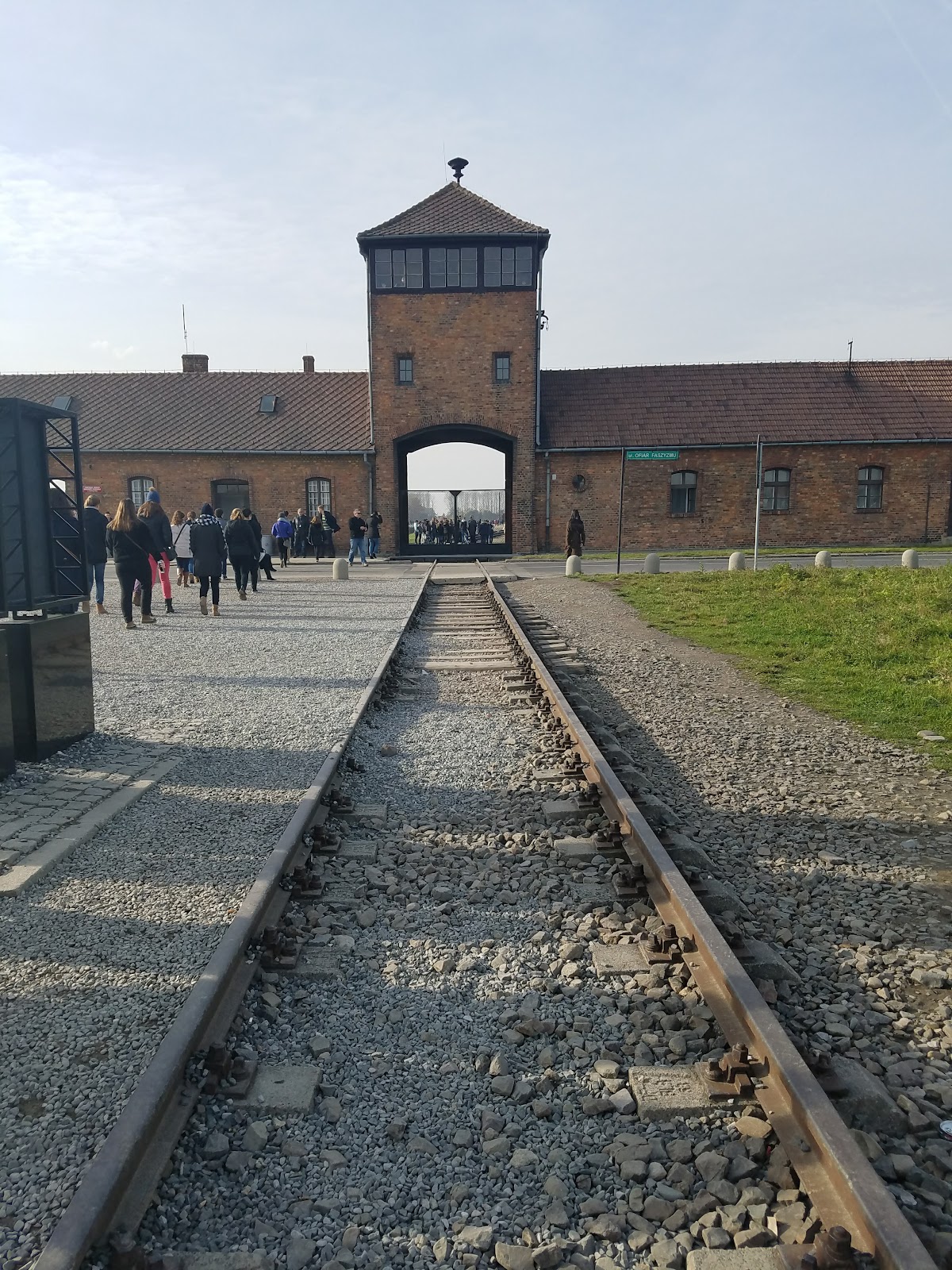
Train tracks went through the camp...that's how big it was

After travelling like sardines in trains cars (above right) for several days with little food, families were separated: men "housed" to the left of these tracks (below)  and women "housed" to the right.  


The buildings they were placed in were basically stables: 


And the rows and rows of buildings truly seemed to go on forever. I wouldn't be able to capture the vastness of the place unless I took my camera up on an airplane. Here's a picture of just one:


Towards the back of the camp, a memorial with engraved words (written in many different languages) gave us one final opportunity to take in the millions of lives that were taken: 


And then we left. I heard someone point out once that Anne Frank, the most "famous" victim of the Holocaust, receives more empathy than any other holocaust victim. In other words, "What about the millions of others who died?" After this trip, I think I understand why. We as humans cannot emotionally comprehend death on such a grand scale. At least I cannot. When I walked through the Anne Frank museum earlier that week, I felt so much for the family and was moved to tears. When I left the camp, however, I had a different feeling; uneasiness and numbness. And I don't think this is necessarily a bad thing. It's simply the way our minds cope. 


 The truth is, even though we may not be able to comprehend it all, it is our duty to try to. I believe we have a responsibility to read, to visit and to remember. It's the least we can do. As the saying goes:

"Those who cannot remember the past are condemned to repeat it."

So now that it has been nearly three weeks since my visit, these are my concluding thoughts. I hope I didn't overstep any boundaries or disrespect the victims with my pictures. I struggled to post this and  texted my mother, "How okay is it to talk about Auschwitz in blog?"

Her response: "How okay would it be to pretend it doesn't exist/didn't happen?" 

She's right. So here it is. 


Wednesday, September 7, 2016

Cheers, an Afty, and A Bit of a Do

I'm already falling behind...we've been here for four days! Today, however, was my all time favorite day so far. We met the other students we will be studying with, spent the afternoon exploring, and then took the most romantic bus tour ever created. But before I share that, here are some pictures of my home sweet home (and the first couple days).

We live on top of a hill that's on top of another hill that is on top of another hill (perhaps the reason why the borough is called Highgate). This is us all piling in with our luggage:


Here's a look into my apartment:


At night the city looks like its a mile away. We can see the lights from our kitchen window... It's pretty wild to think I'm living barely forty-five minutes from the center of the city. I don't think it has quite hit me yet, how lucky I am to be here. We were reminded today how rare it is to be able to live only a zone over from Central London. And I'm here? As an eighteen-year-old college student? It's truly amazing to have the opportunity.


 The inside of our flat looks brand new (because it is: we are its first residents since renovation!), but the building is extremely old. I'm glad they kept these vintage-y windows because each morning when the sun comes in, I feel like I could be a Bennet or a Bingley. Then, I wake up, get ready, and walk to the tube, hoping to arrive approximately 45 minutes after stepping out of the house. (So far it hasn't quite worked out that way, but it will...I think). Here's some pictures of the Arcadia center:


On Sunday, the day we flew in, Arcadia staff treated us to dinner at WagaMama, a delicious Thai restaurant in Central London. This was probably to prevent us from taking a nap so we could adjust to the local time, which was definitely a smart idea because otherwise I probably would have fallen asleep. 


The next day (Monday), we went on a self-navigated tour of the city as part of an orientation activity. Here's some typical touristy pictures:


And here's us back in Highgate: our first official grocery trip!

Next month we probably won't be as ecstatic to be taking on this part of #adulting. Here's a fun fact.  Grocery bags cost 2 pence. Each. So this girl is thankful her mother packed her a reusable grocery bag (that is also insulated!) It made the culture shock of food-shopping a little more bearable :)


And with that, I've completely run out of time. Its almost two in the morning here, so I guess I'll save the "a bit of a do" portion of this blog for a later post. Here's a sneak peek:


Can we say, ADORABLE? (The bus, that is, not me). 

Anyway, more on that later!

Cheers,
LKM